

Dr. Shahida Naghma is a Fertility & IVF Specialist with more than 10 years of clinical experience. She completed her MBBS from Army College of Medical Sciences, Delhi, followed by an MS in Obstetrics & Gynecology from VMMC & Safdarjung Hospital. She also completed a Clinical Fellowship in Reproductive Medicine at Sir Ganga Ram Hospital, Delhi, where she was a Gold Medallist. Her clinical interests include female infertility, endometriosis, fibroids, low ovarian reserve, fertility preservation, and fertility-enhancing procedures involving ovarian cysts.
For women looking for an Ovarian Cyst Specialist in Saket, understanding the type and nature of a cyst is an important first step before deciding whether treatment is required.
What Are Ovarian Cysts?
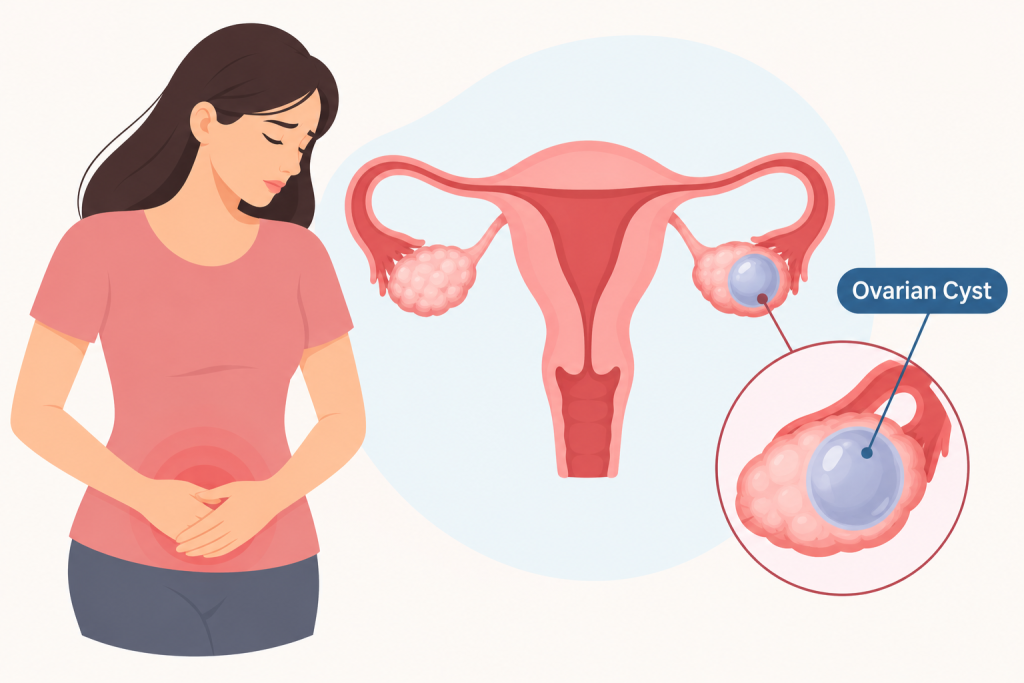
Ovarian cysts are fluid-filled sacs that can develop in or around the ovaries. They are common during the reproductive years and many are benign and may resolve without treatment. However, some cysts can become larger, persistent, painful, or associated with other reproductive health concerns.
Symptoms can vary considerably. Some women may have no noticeable symptoms, while others may experience pelvic discomfort, bloating, changes in periods, pain during intercourse, or pressure in the lower abdomen. Persistent or unusual symptoms should be medically evaluated rather than self-diagnosed.
When Should an Ovarian Cyst Be Evaluated?
A medical consultation may be appropriate when a cyst is repeatedly detected on scans, causes persistent pelvic pain, becomes larger, affects daily activities, or is associated with menstrual or fertility concerns.
Evaluation generally begins with a discussion of symptoms and medical history followed by a clinical examination. Depending on the situation, ultrasound or other investigations may help determine the cyst’s size, appearance, and location.
An Ovarian Cyst Specialist in Saket can use these findings to determine whether observation, follow-up imaging, medication, or a surgical approach may be appropriate.
Does Every Ovarian Cyst Need Surgery?
No. Treatment depends on factors such as the type of cyst, its size, symptoms, age, reproductive plans, and imaging characteristics. Many functional cysts may be monitored because they can disappear naturally.
Surgery may be considered when a cyst is persistent, symptomatic, large, suspicious on imaging, or associated with complications. For women planning pregnancy, treatment decisions may also consider ovarian reserve and preservation of healthy ovarian tissue.
This is why an Ovarian Cyst Specialist in Saket should assess the complete clinical picture rather than recommending surgery based only on the presence of a cyst.
Ovarian Cysts and Fertility
Some ovarian conditions may be associated with fertility difficulties, although the presence of a cyst does not automatically mean that a woman will have infertility.
Certain conditions, such as endometriotic cysts, can occur alongside fertility problems. Treatment therefore needs to consider both the cyst itself and the woman’s reproductive goals.
Dr. Shahida’s background in reproductive medicine and fertility care can be particularly relevant when ovarian cyst management overlaps with pregnancy planning or infertility evaluation. Her listed areas of interest include fertility-enhancing procedures for ovarian cysts and endometriotic cysts.
How Is Treatment Planned?
An individualized treatment plan may consider ultrasound findings, symptoms, previous medical history, age, fertility goals, and other gynecological factors. Patients should understand why a particular treatment is being suggested and what alternatives may be available.
When surgery is appropriate, the surgeon may discuss the procedure, possible risks, recovery expectations, and how the treatment may affect future fertility. Clear communication is an important part of responsible ovarian cyst care.
For patients consulting an Ovarian Cyst Specialist in Saket, the aim should be accurate diagnosis followed by treatment that matches their individual medical and reproductive needs.
Frequently Asked Questions
1. Can ovarian cysts go away on their own?
Yes, some functional ovarian cysts may resolve naturally. However, follow-up may be recommended depending on their appearance, size, symptoms, and clinical circumstances.
2. Are ovarian cysts always dangerous?
No. Many ovarian cysts are benign. However, persistent, painful, enlarging, or unusual cysts require proper medical assessment.
3. Can an ovarian cyst affect pregnancy?
Some ovarian conditions can be associated with fertility difficulties, particularly when conditions such as endometriosis are involved. The impact varies from person to person.
4. When is ovarian cyst surgery considered?
Surgery may be considered for selected cysts that are persistent, symptomatic, large, suspicious, or causing complications. The decision should follow appropriate medical evaluation.
5. Can ovarian cyst treatment preserve fertility?
In women who wish to conceive, treatment planning may take ovarian reserve and future fertility into consideration. The appropriate approach depends on the individual condition.
Conclusion
Ovarian cysts can have very different causes and clinical characteristics, so treatment should not be based on symptoms alone. Proper assessment helps determine whether monitoring, further investigation, or treatment is appropriate.
For women searching for an Ovarian Cyst Specialist in Saket, Dr. Shahida Naghma’s experience in gynecology, reproductive medicine, fertility care, and fertility-enhancing procedures provides a foundation for individualized evaluation. Her qualifications and 10+ years of clinical experience support a patient-focused approach to complex reproductive health concerns.