

Dr. Shahida Naghma is a Fertility and IVF Specialist with over 10 years of clinical experience. She completed her MBBS from Army College of Medical Sciences, Delhi, followed by an MS in Obstetrics & Gynecology from VMMC & Safdarjung Hospital. She also completed a Clinical Fellowship in Reproductive Medicine from Sir Ganga Ram Hospital, Delhi. Her clinical interests specifically include management of low ovarian reserve, fertility preservation, female infertility, and assisted reproductive techniques.
For women considering Ovarian Reserve Testing in South Delhi, understanding ovarian reserve can be an important part of fertility assessment, particularly when pregnancy planning has been delayed or there are concerns about reproductive potential.
What Is Ovarian Reserve?
Ovarian reserve refers to the remaining supply of eggs in the ovaries. It is different from egg quality. A woman may have a certain ovarian reserve, but this does not by itself predict whether she will or will not become pregnant.
Ovarian reserve generally changes with age, although the rate of decline differs between individuals. Previous ovarian surgery, certain medical treatments, and some reproductive conditions may also affect ovarian reserve.
This is why Ovarian Reserve Testing in South Delhi should be interpreted alongside age, menstrual history, fertility history, and other clinical factors rather than considered as a standalone fertility prediction.
Why Is Ovarian Reserve Testing Done?
Testing may be recommended when a woman is experiencing difficulty conceiving, considering fertility preservation, planning pregnancy at a later age, or preparing for assisted reproductive treatment.
Women with a history of ovarian surgery, certain fertility conditions, or previous fertility treatment may also benefit from an individualized assessment.
The purpose is not simply to produce a number. The results can help a fertility specialist understand ovarian response and discuss appropriate reproductive options.
How Is Ovarian Reserve Assessed?
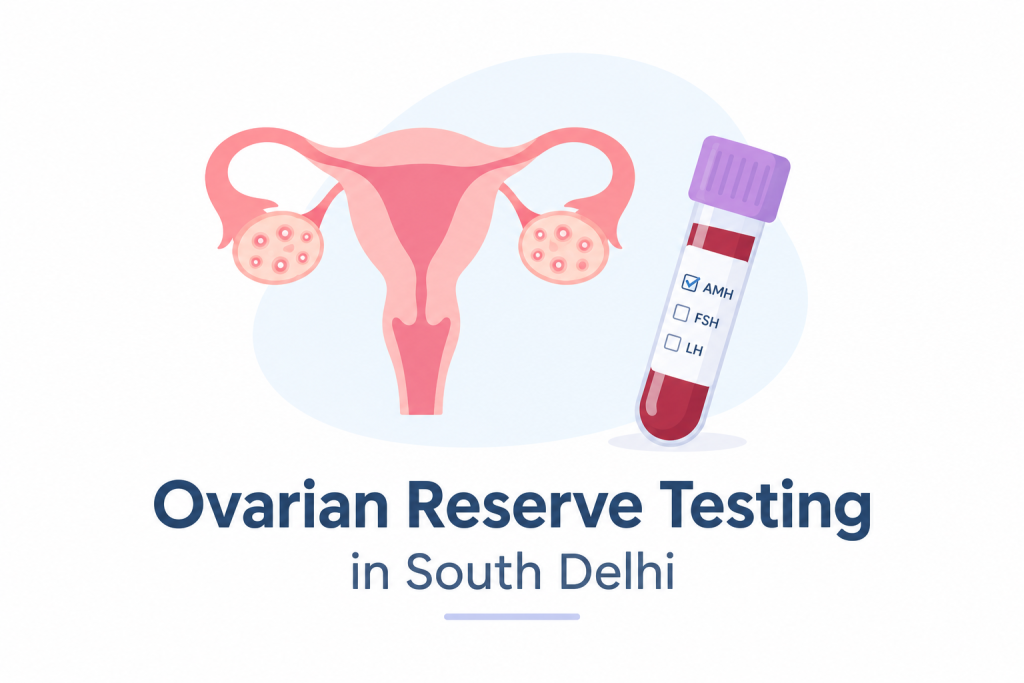
A fertility specialist may use more than one method to assess ovarian reserve. Common assessments include blood testing for Anti-Müllerian Hormone (AMH) and ultrasound evaluation of the antral follicle count (AFC).
Other hormone tests may sometimes be considered depending on the patient’s medical history and menstrual cycle.
The interpretation of these tests is important. A single result should not be used to determine a woman’s overall fertility or guarantee the success or failure of fertility treatment.
For this reason, Ovarian Reserve Testing in South Delhi is best approached as part of a complete fertility evaluation.
Does Low Ovarian Reserve Mean Infertility?
Not necessarily. Low ovarian reserve may indicate a reduced number of remaining eggs, but it does not automatically mean that natural conception is impossible.
Age, ovulation, fallopian-tube health, sperm factors, medical history, and egg quality also influence fertility.
A low ovarian reserve result can, however, be useful information when discussing reproductive planning. Depending on the individual’s circumstances, a specialist may discuss trying to conceive, fertility preservation, or assisted reproductive options.
Dr. Shahida Naghma’s Experience in Fertility Care
Dr. Shahida’s professional experience includes working as a Senior IVF Specialist at India IVF, Basant Lok, Consultant at Birla Fertility & IVF, and Clinical IVF Fellow at Sir Ganga Ram Hospital. Her listed areas of special interest include low ovarian reserve management, fertility preservation, social freezing of eggs, sperm and embryos, and advanced assisted reproductive techniques such as IUI, IVF and ICSI.
This reproductive-medicine background is relevant for women seeking Ovarian Reserve Testing in South Delhi, especially when testing is being considered alongside fertility planning or preservation.
When Should You Consider Testing?
There is no single testing schedule suitable for every woman. A consultation may be useful if you are concerned about declining fertility, have been trying to conceive without success, have a history of ovarian surgery, or are considering freezing eggs for future reproductive planning.
The results should always be discussed with a qualified fertility specialist who can explain what they mean in the context of your age and individual reproductive history.
Frequently Asked Questions
1. What does an ovarian reserve test tell you?
It provides information about the estimated quantity of eggs remaining in the ovaries. It does not directly measure egg quality or guarantee natural pregnancy.
2. Is AMH enough to assess ovarian reserve?
AMH is an important marker, but it may be interpreted alongside ultrasound findings such as antral follicle count and the patient’s overall fertility history.
3. Can ovarian reserve improve naturally?
Ovarian reserve generally declines over time and cannot be reliably increased through a specific treatment. However, fertility planning can help women make informed decisions based on their individual circumstances.
4. Does low AMH mean IVF is necessary?
No. A low AMH result does not automatically mean IVF is required. Treatment recommendations depend on age, fertility history, ovarian response, sperm factors, and other clinical findings.
5. Can ovarian reserve testing help with egg freezing decisions?
It can provide useful information about expected ovarian response and may help a fertility specialist discuss fertility-preservation options. The decision should consider age and personal reproductive goals as well.
Conclusion
Ovarian reserve testing can provide valuable information when a woman is planning pregnancy, experiencing fertility concerns, or considering fertility preservation. However, test results should never be interpreted in isolation.
For women considering Ovarian Reserve Testing in South Delhi, Dr. Shahida Naghma combines more than 10 years of fertility and gynecology experience with specialist training in reproductive medicine. Her clinical focus on low ovarian reserve, fertility preservation, and assisted reproduction allows fertility evaluation to be connected with the patient’s broader reproductive goals.
Main keyword: Ovarian Reserve Testing in South Delhi — 7 times
Secondary keywords: Low Ovarian Reserve Specialist in South Delhi, AMH Testing in South Delhi, Ovarian Reserve Assessment, Fertility Testing in South Delhi, Fertility Specialist in South Delhi.